
The Proposal
The Joint Peace Assembly (JPA) is engineered based on evidence. Here is exactly how it is structured, how delegates are chosen, and how the process unfolds.
Every successful modern peace process shares four structural elements: international sponsorship, multi-stakeholder inclusion at all stages, the participation of common interest groups, and full transparency of negotiations. The Joint Peoples Assembly is designed to include all four from the start — not as goals, but as structural requirements.
The Problem with the Purely Diplomatic Path
Trow Davis, the architect of the 'Pax Democratica' concept, identified the structural reason why diplomatic peace processes repeatedly fail: any proposal must pass through concentric layers of broader and broader political party approvals — and at every layer, agendas and interests threaten to tear it apart.
How the Assembly Bypasses the Impasse
The Joint Peace Assembly bypasses this impasse through a hybrid mandate: half of the civil society in the Assembly is elected directly by communities through sectoral elections, while the political half is appointed proportionally from elected parties. Neither half depends on any government remaining in power, and no single party or coalition can veto the process.
The role of the 'Friends of Pax Democratica' coalition is a single enabling act: to exert constant pressure on the Knesset and the Palestinian Legislative Council to pass the legislation authorizing the Assembly elections. Once that legislation is passed, the Assembly is formed directly — no additional political filter required.
The Assembly relies on three structural parities — not just ideals, but design requirements that give the process legitimacy and practical effectiveness.
Gender Parity
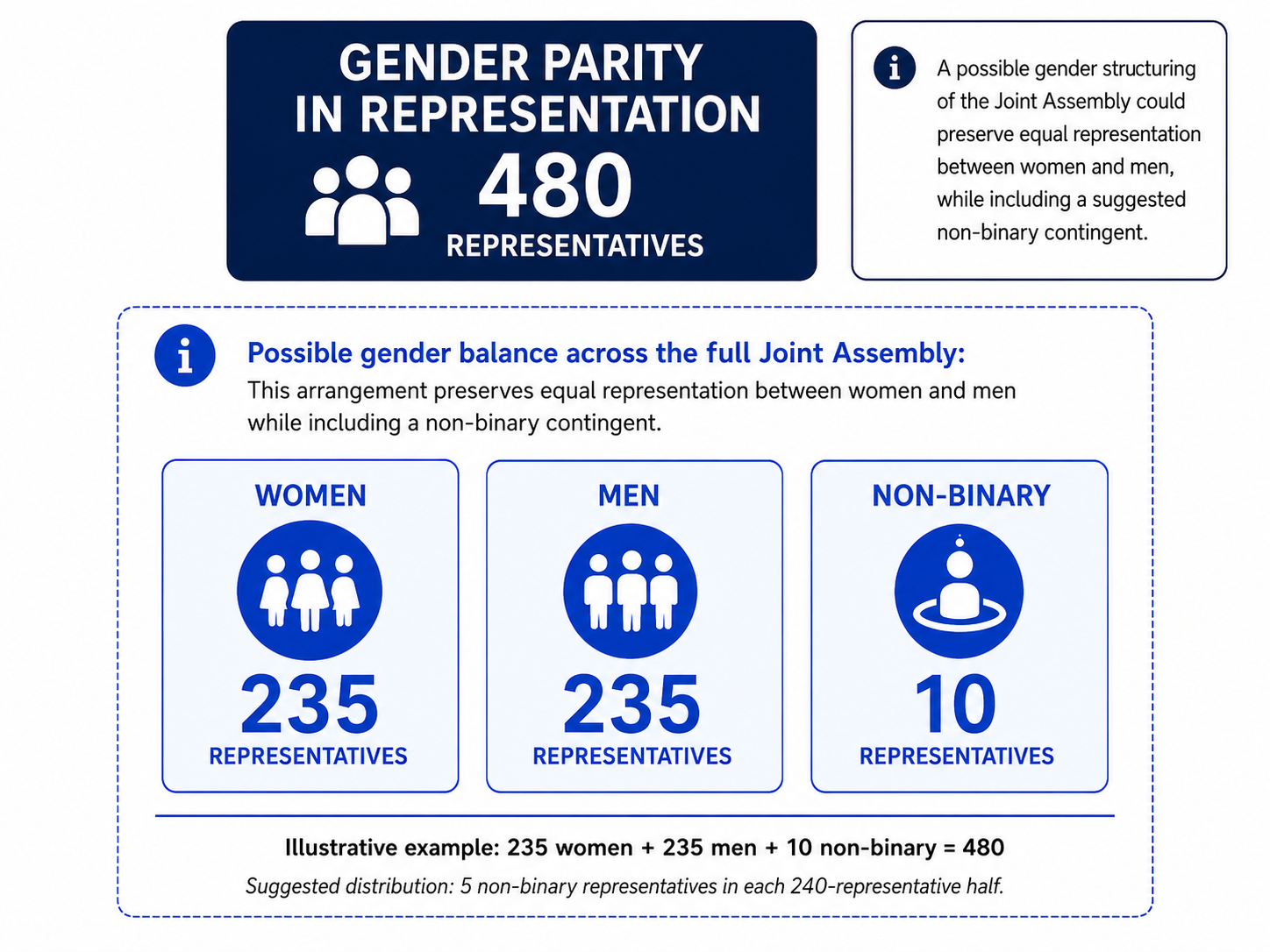
Equal representation of males and femalesEqual numbers of male and female delegates — baked into the election rules for every participating organization from the start, not applied as a later quota.
ℹ Why this?
Territorial Parity
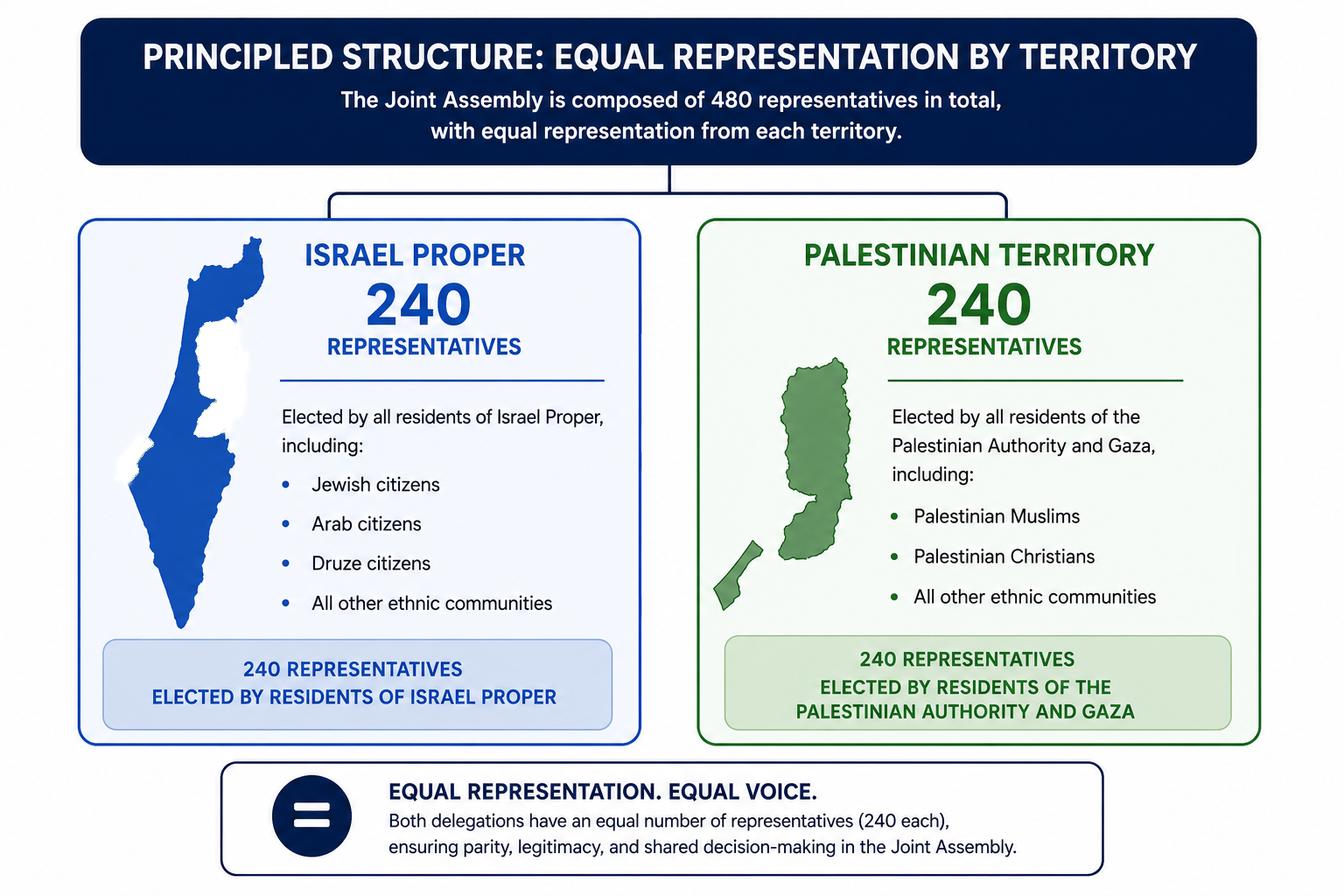
Equal representation from each sideAn equal number of representatives from Israel Proper (including all minorities) and the Palestinian territories — West Bank and Gaza, including their minorities and Jewish Settlers.
ℹ Why this?
Political and Civil Society Parity
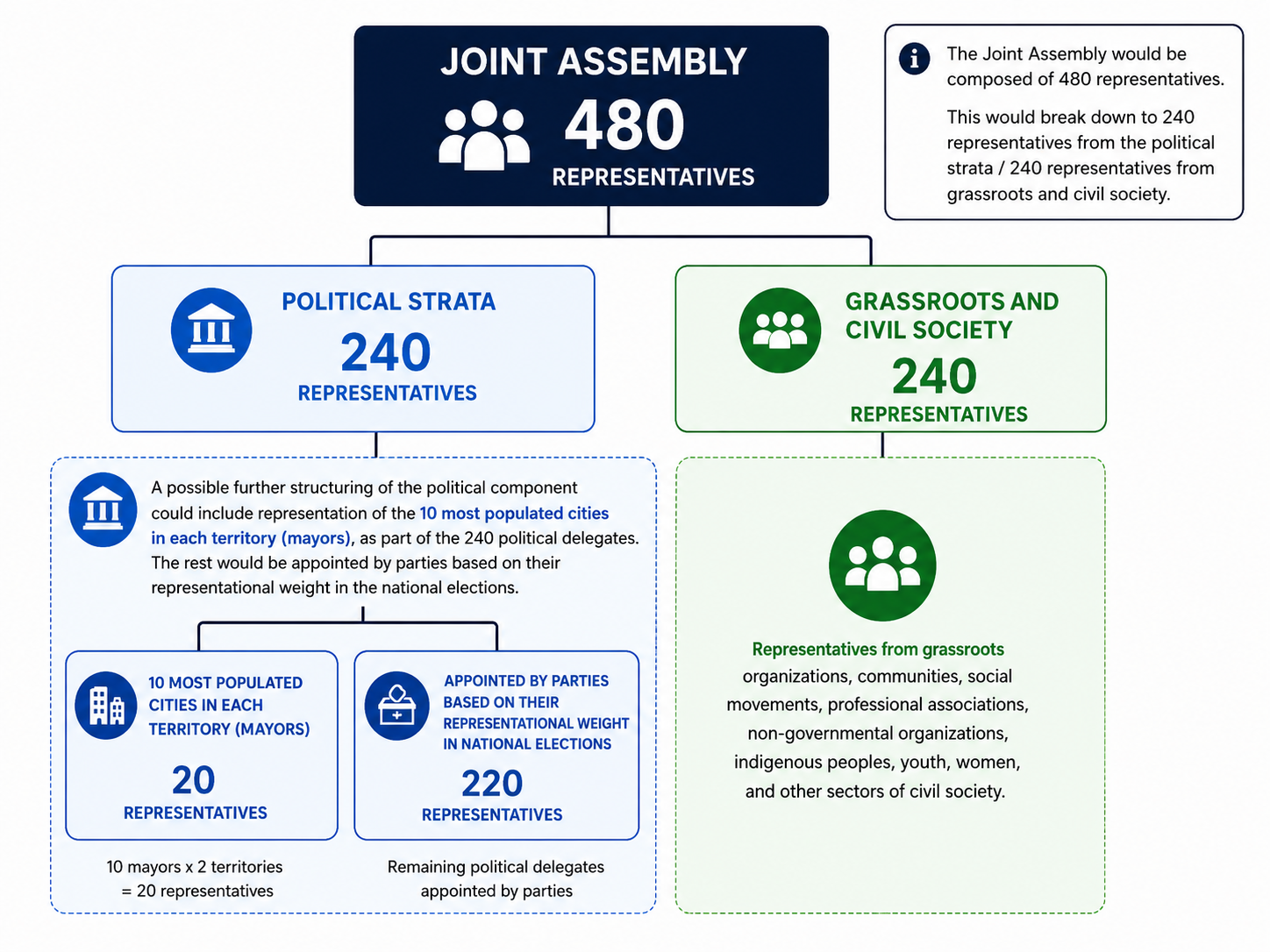
Political and civic voices at the table togetherEqual numbers of politically appointed delegates — drawn from elected parties proportional to their democratic weight — and elected civil society delegates, drawn from organized civic sectors.
ℹ Why this?
Civil Society Delegates
Civil society delegates are elected directly by their sectors. Eligible sectors include labor unions and trade federations, civic organizations and NGOs, religious institutions, business and professional associations, academic institutions, cultural and artistic organizations, and youth organizations.
The exclusion criterion is simple: delegates may not be members of a terrorist organization. This structural criterion — not a political test applied by governments — solves the 'Hamas' impasse. Hamas cannot authorize or withdraw legitimacy from a body that does not emerge from its political ecosystem.
Political Delegates
Political delegates are appointed by parties in proportion to their weight in democratic national elections. One version of the proposal includes representation of mayors from the ten most populous cities in each region as part of the political delegation.
This proportional appointment ensures that political currents within each community are represented — while the civil society half of the Assembly ensures that political institutions cannot dominate the process.
Based on the framework established by peace process scholar Thania Paffenholz, the Assembly integrates three distinct modes of civil society participation, each serving a different function.
Inclusive Commissions
Joint bodies comprising Assembly delegates and civil society representatives from both sides, addressing specific issue areas. Civil society contributes through focused dialogue and expertise within a structured and bounded format.
ℹ Why this?
High-level Problem-Solving Workshops
Less formal forums where civil society actors and community representatives interact with Assembly delegates, to build trust and explore solutions outside formal constraints. These workshops create space to navigate historical grievances and traumas through more flexible discussions than formal channels allow.
ℹ Why this?
Regular Public Consultations
Public forums that allow for a broader range of perspectives and give citizens a direct way to engage with the Assembly. This link ensures that negotiations are not detached from societal needs and sentiments, fostering legitimacy and a wider path to healing through collective participation.
ℹ Why this?
A coalition of 'Friends of Pax Democratica Palestine-Israel' — governments, international organizations, and civil society bodies committed to the process — provides three things: mediation when the Assembly reaches an impasse, financial support for the entire process, and political legitimacy that protects the process from the pressures of regional spoilers.
Every delegate receives the same salary and budget for their office and staff, funded by the coalition. Equal resources are both practical and symbolic: both peoples enter the room as equals. Additionally, the injection of funds into communities through participation increases public adoption of the process.
The coalition plays a key role in exerting pressure on the Knesset and the Palestinian Legislative Council to pass the enabling legislation that authorizes and funds the Assembly elections — making support for the Assembly a condition for diplomatic and economic engagement.
ℹ Why this?
The large and diverse delegations in the Assembly will naturally surface grievances and traumas that diplomatic negotiations have long brushed aside. The process creates formal space — in its agenda — for hearing testimonies across the table and collective acknowledgment of memorials of past atrocities.
Collective trauma is not deferred until 'real' negotiations begin. This relies on the core insight of transitional justice: that sustainable peace requires something closer to truth and reconciliation than a contract signed under pressure. Communities whose suffering has not been acknowledged will not respect agreements that ask them to move on.
ℹ Why this?
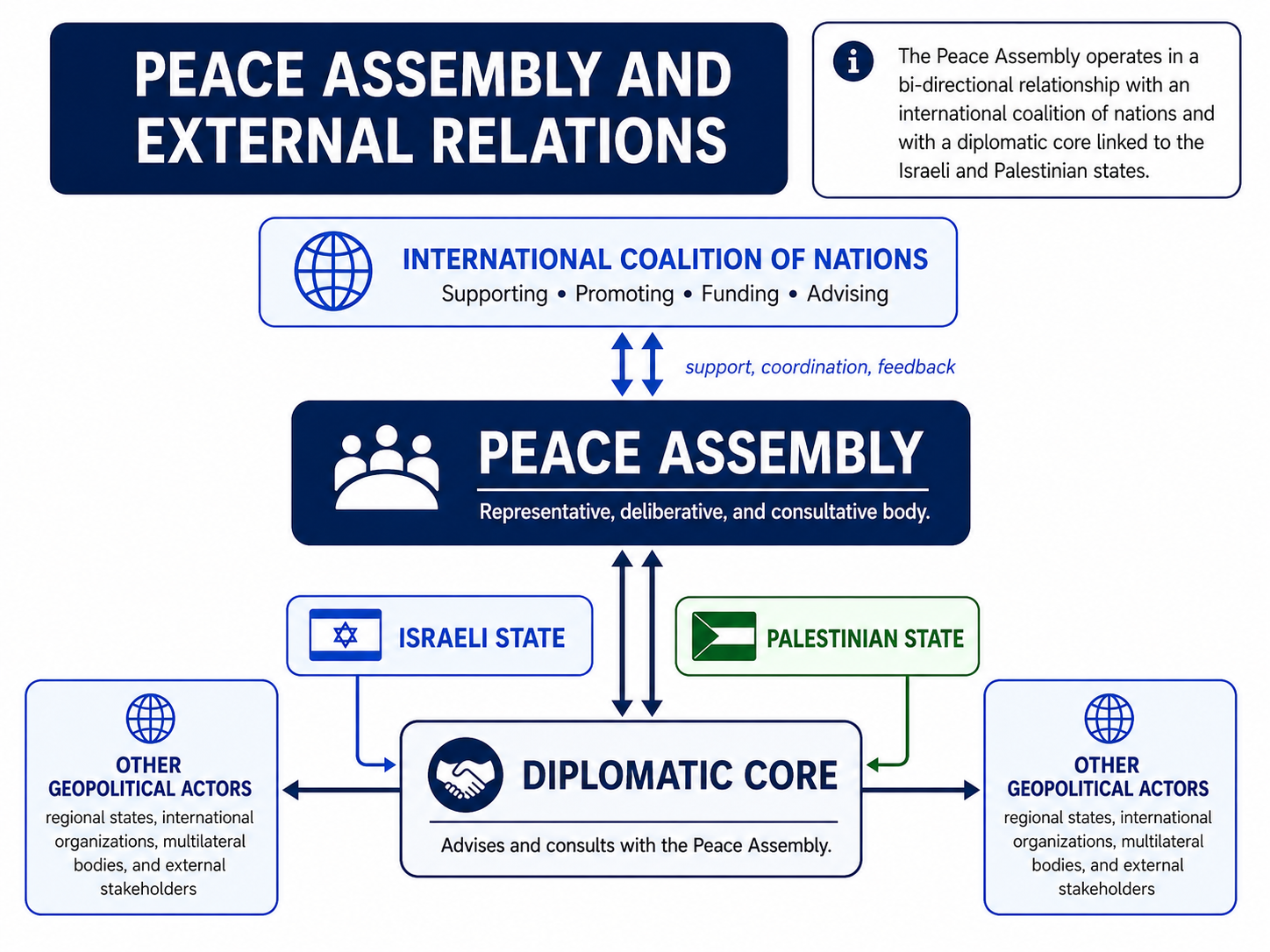
The Joint Assembly will be only one element of a broader range of support, recognizing the fact that it cannot directly address geopolitical interests. To address those interests, a diplomatic element will still be needed in the periphery, working to reconcile issues that may arise regarding the geopolitical impact of direct negotiations. Diplomatic efforts will be under the auspices of state leadership and will be integrated as an advisory role in the Assembly as well.
Also, there will be a key element consisting of a transnational body called 'Friends of Pax Democratica', a coalition or council of nations committed to funding, sponsoring, and supporting the process.
Building Momentum
Promoting the idea and forming coalitions and advocacy alliances — civil society organizations, peace groups, governments, and diaspora communities — creating the political pressure necessary to start the process.
Internal Debate
Initiating public debate and simultaneous discussions in both Israeli and Palestinian communities — building sufficient civic awareness and political will to legitimize the Assembly election process in each community.
Coordinated Electoral Laws
Enacting coordinated electoral laws in both communities for the parallel election of civil society representatives to the Assembly. Both the Knesset and the Palestinian Legislative Council pass enabling legislation, coordinated through international mediators.
Assembly Convening
Establishing the binational Joint Peace Assembly. Delegates take their seats, equal resources are distributed, and the structured trust-building and negotiation process begins.
The Assembly will be convened for the sole purpose of negotiating a peace agreement. It is not intended to replace the Knesset or the Palestinian Legislative Council. Its specific mission is to resolve the hostility between the Israeli and Palestinian peoples. It may be dissolved after an agreement is reached, or retained in a transformed capacity to manage implementation and address transnational issues.
The argument is made. Now it's time for action.
The most effective thing individuals can do is pressure the peace organizations they have access to — urging them to seriously discuss this proposal and support building a coalition to advocate for it.